How to Write an Autistic Resume ? Tips, Examples and Templates
Are you an autistic person looking for a job? Well, this can feel quite overwhelming. You might have excellent technical skills, strong attention to detail, or a deep understanding of your favourite subject but struggle to explain your strengths on your autistic resume.
Besides that, only 33% of Canadian adults on the autism spectrum are employed. (Canadian Association for Supported Employment)
The reason? This is mostly because these people don’t even know how to write a CV for autism.
And no, you don’t need to change who you are to create a professional resume.
Many people don’t know this, but writing an autism resume simply means presenting not only your qualifications and achievements but also your abilities in a way that helps employers understand your value.
Let’s understand how you can write an exceptional autism CV.
What Autism Actually Is?
Before moving on to the steps to write a resume for autistic adults, let’s first understand what autism actually is.
To begin with, autism is also known as Autism Spectrum Disorder (ASD). It is basically a lifelong neurodevelopmental difference that affects not only how a person perceives and communicates but also how they interact with the world.
However, you must keep in mind that autism is not an illness or a disease. Instead, it is a form of neurodivergence.
Neurodivergence means that the brain develops and functions differently from typical patterns. Legally and medically, it is classified as a developmental disability.
Autism is also recognized as a developmental disability in many legal and medical contexts.
In addition to this, being autistic doesn’t automatically determine someone’s professional abilities. As an autistic person, you might excel not only at pattern recognition and accuracy but also at independent work and identifying inconsistencies.
A successful neurodivergent CV should therefore focus on your qualifications and relevant abilities. It shouldn’t assume that every autistic person has the same strengths or workplace needs.
This is why many autistic people often seek assistance from the best resume writing service in Toronto.
Should You Mention Autism in Your CV?
One of the main concerns among neurodivergents is, ‘Do I have to tell my employer I have autism?’
When You Shouldn’t?
Well, you generally do not have to mention autism or any other disability on your resume. Your resume is a professional document designed to demonstrate why you are suitable for a particular role. It doesn’t need to contain your complete medical history.
A neurodivergent resume can highlight not only your experience and education but also your achievements and relevant skills without mentioning your diagnosis.
When You Should?
However, disclosing autism to employer is your personal choice. You can do this if you want to explain a specific career circumstance, discuss workplace adjustments, or apply through a programme that specifically recruits neurodivergent candidates.
You must remember that an autism resume writing strategy should always reflect your comfort level and the requirements of the opportunity. You can disclose it during the application process, at an interview, or later when discussing workplace accommodations.
What Are the Steps to Write a Top-Notch CV for Autism?
To write a resume for autism, you have to follow a few steps.
These steps include not only understanding what the employer needs and creating a professional summary but also highlighting your skills and achievements.
You must also ensure that you add relevant work experience and use the right resume keywords. Also, make sure that you choose a simple layout and review your resume before submitting.
Note the duties and skills the employer wants
Two or three clear sentences
Match your abilities to the role
Paid, volunteer, freelance or academic
Take them from the job advertisement
Clear headings and enough white space
Check accuracy and remove extra details
Understand What the Employer Needs
Before writing your neurodiverse CV, you have to read the job description carefully. You must identify not only the main responsibilities and qualifications but also the skills the employer wants. This will help you decide which experiences deserve the most attention.
You have to focus on connecting your abilities to the role rather than listing every task you have ever completed. You must also include relevant evidence that shows you can contribute to the organization.
Create a Clear Professional Summary
Your CV should begin with a short professional summary that introduces your background and strongest relevant skills. Two or three sentences are usually enough.
These are a few autism resume examples for a professional summary.
‘Dedicated professional with experience implementing behavioural intervention plans and supporting clients with ASD, increasing adaptive living skills through evidence-based techniques.’
‘Results-driven Software Engineer with 3+ years of experience designing, debugging, and maintaining scalable codebases and technical systems. Deeply skilled in Python, SQL, and systems architecture with a strong track record of deep-focus problem-solving and systematic troubleshooting. Eager to contribute logical problem-solving and technical expertise to this company.’
Highlight Your Skills and Achievements
Your resume should still focus on your abilities and achievements even if you have ADHD along with autism. Your ADHD CV can also highlight creative thinking and project management experience.
Similarly, your ADHD resume should use specific examples of what you have achieved and the skills you bring to the workplace.
Add Relevant Work Experience
Besides that, you have to add relevant experience to your resume. You must include not only paid employment and internships but also volunteering, freelance projects, and relevant academic work.
Instead of writing ‘Responsible for organizing files’, you can try ‘Organized more than 200 digital records to improve document retrieval and accuracy’. Just remember that everything in your CV must be true.
Responsible for organizing files.
Organized more than 200 digital records to improve document retrieval and accuracy.
Use the Right Keywords
You must also know that many employers use applicant tracking systems (ATS) to organize and screen applications. To pass this screening, you have to use relevant keywords in your document.
For that, you have to read the job advertisement carefully. This will help you determine the keywords.
Choose a Simple and Professional Layout
You must remember that a good neurodivergent CV guide emphasizes clarity rather than complicated design. This is why you have to use not only consistent headings and readable fonts but also bullet points.
Also, make sure that you use enough white space. This will allow you to make the document easy to scan.
A neurodivergent CV template can help you organize your information without starting from scratch.
Review and Improve Your Resume
Last but not least, you can use these resume tips for autistic job seekers to check whether your document is easy to understand.
You must also ensure that you keep the most relevant information near the top, use consistent formatting, and remove unnecessary details.
How Can You Make It Better?
Some Additional CV Tips for Autistic Job Seekers
Small improvements can make a meaningful difference. Your resume does not need to be perfect on the first attempt. Focus on making it accurate, relevant, and easy to read.
The following are neurodivergent resume tips to improve its quality.
Tailor Your Resume for Every Job
When you learn to write a CV for autistic adults, you must remember that you don’t need to include everything about yourself. You can simply include your professional summary, skills, and work experience for the position you want.
You must also know that each job description has its own requirements. This is why you can consider keeping a master resume and creating a tailored copy for each application.
Keep one master resume with all your experience. For each application, make a copy and keep only the details that match the job advertisement.
Use Examples to Demonstrate Your Strengths
In addition to this, looking at autism CV examples can help you understand how you can structure not only your qualifications and work history but also your skills.
However, make sure that you use examples for inspiration rather than copying someone else’s experience or wording.
Consider Getting Professional Support
Many people often struggle with writing a resume for neurodivergence. Do you also find it difficult? No worries!
You can search for ‘resume writer near me’. This will allow you to get one-to-one support. You must look for someone who understands neurodiversity and will respect your preferences rather than making assumptions about your abilities.
Make sure that the writer not only helps you communicate your genuine strengths and maintain your voice but also tailors your application to your goals.

Present your qualifications, skills and achievements clearly for the roles you want.
Autistic Resume Template
This autism resume template will help you understand how you can write and format your resume more effectively.
However, you must keep in mind that this template is just to make things clearer for you. And the format and requirements may vary based on your industry and employer’s requirements.
You can also use this template for your autism disclosure job application.
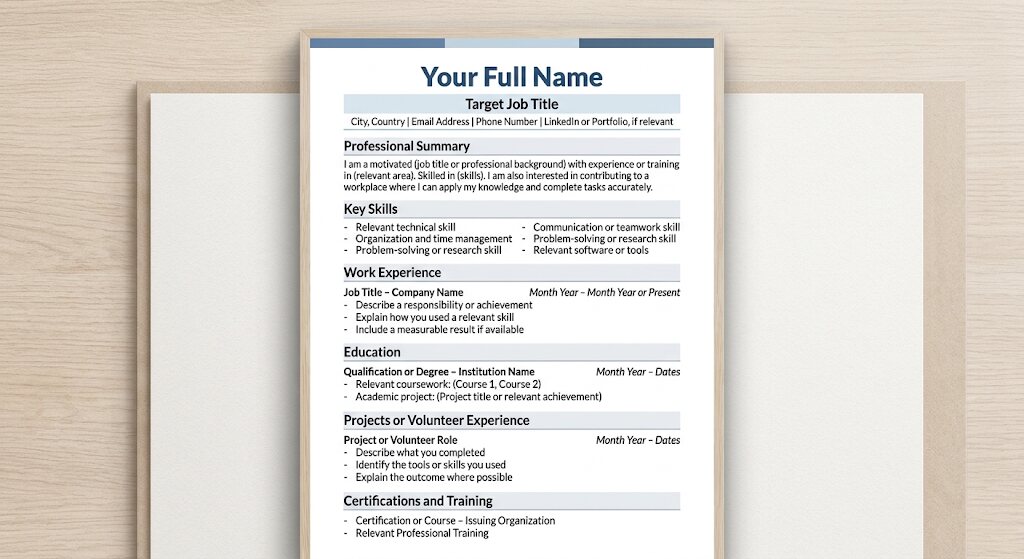
Your Full Name
Target Job Title
City, Country | Email Address | Phone Number | LinkedIn or Portfolio, if relevant
Professional Summary
I am a motivated (job title or professional background) with experience or training in (relevant area). Skilled in (skills). I am also interested in contributing to a workplace where I can apply my knowledge and complete tasks accurately.
Key Skills
- Relevant technical skill
- Communication or teamwork skill
- Organization and time management
- Problem-solving or research skill
- Relevant software or tools
Work Experience
Job Title – Company Name
Month Year – Month Year or Present
- Describe a responsibility or achievement
- Explain how you used a relevant skill
- Include a measurable result if available
Education
Qualification or Degree – Institution Name
Year of Completion or Expected Graduation
- Relevant coursework: (Course 1, Course 2)
- Academic project: (Project title or relevant achievement)
Projects or Volunteer Experience
Project or Volunteer Role
Month Year – Month Year
- Describe what you completed
- Identify the tools or skills you used
- Explain the outcome where possible
Certifications and Training
- Certification or Course – Issuing Organization
- Relevant Professional Training

FAQs
Is it illegal to hide autism in resume in Canada?
No, it is not illegal to leave autism off your resume in Canada. In fact, you are under no legal obligation to disclose not only any medical condition and disability but also neurodivergence to a potential employer during the hiring process.
Should I disclose autism on my resume?
You can disclose autism on your resume. But it is generally not required or recommended. However, you can include your diagnosis only if you genuinely want to share it or have a specific reason to do so. Your resume should primarily demonstrate your qualifications and suitability for the position.
When to disclose neurodivergence at work?
You can disclose neurodivergence during recruitment or before an interview if you need adjustments. You can also do it after receiving a job offer when discussing workplace support.
How to write a resume with autism?
To write a resume with autism, you must first understand what the employer needs and create a professional summary. And don’t forget to highlight your skills and achievements.
Besides that, you should not only add relevant work experience and use the right resume keywords but also choose a simple layout and review your resume before submitting.
To Conclude
Many neurodivergent people think that writing a CV is a Herculean task. You must keep in mind that writing an autism resume is not about hiding who you are or trying to fit a particular stereotype.
It is about helping employers understand not only your skills and experience but also your potential.
To write a top-notch CV, you have to understand the employer’s needs and create a professional summary. Also, highlight your skills and achievements.
On top of that, you must not only add relevant work experience and use the right keywords but also choose a professional layout and review your resume before submitting.
Most importantly, remember that you can decide whether to disclose your autism. Your diagnosis doesn’t replace your qualifications or define everything you can contribute.
Ready to Present Your Strengths With Confidence?
Our professional resume writers can help you build a clear, role-focused resume that shows your skills, experience and achievements while keeping your own voice.
Get My Resume Written

Amanda Smith works as a professional writer at Resume Agency CA, and she shares her expertise through blog posts that contain practical tips and easy-to-understand advice about writing resumes and cover letters. She understands the challenges job seekers face and writes in a clear, friendly way that makes career advice easy to follow. Amanda shares useful tips through his blogs, which provide readers with real examples and detailed instructions to help them build effective resumes, write successful cover letters, and increase their chances of securing employment.